AI isn't coming for your career.
It's coming for the part of your work you were already underpaid for.
This is a slope, not a cliff — and slopes reward the people who start walking early. The AI-Proof Freelancer is a research-backed, no-fluff playbook that turns AI from a threat to your rate into the reason you can raise it.
Written by Kundan Kumar — 21 years leading global technology and security through disruption after disruption, from launching a country's first modern mobile network to board-level cyber accountability at a multi-country group. Recognised in the CISO Power 100 Index 2025 (#RISKEurope).
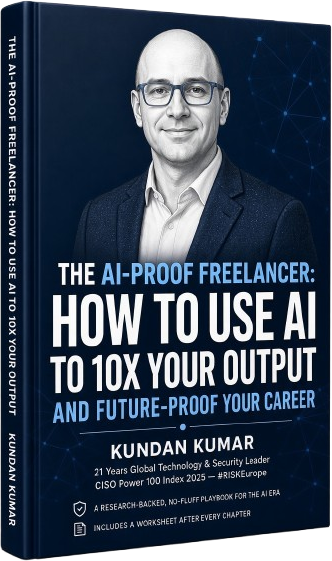
The AI-Proof Freelancer
A Research-Backed, No-Fluff Playbook for the AI Era. Includes a worksheet after every chapter.
Nothing about your work broke. The price of it did.
AI is not eliminating knowledge work wholesale. It is eliminating the tolerance for low-leverage work. That single sentence explains why the same employers cutting AI-exposed roles are hiring AI-literate people faster than ever — and why your last three quotes felt harder to defend than the three before them.
Hourly billing now punishes you for getting better
If AI halves your task time and you bill by the hour, you just halved your income for delivering identical value. Keep billing hours and you compete directly with cheaper AI-augmented freelancers — and with the tools themselves.
Raw, unguided AI use quietly causes cognitive atrophy
MIT research reported in Forbes found heavy AI reliance produces reduced cognitive engagement, fewer original insights, weaker recall, and less ownership of your own work. The tool that multiplies your output can hollow out the judgment clients pay you for.
More tools is not the answer — and it's the default reflex
Tool sprawl adds context-switching and output mistrust, cancelling out the hours AI was supposed to save. You end up learning interfaces and shuttling text between apps instead of raising your leverage.
A slope is better news than a cliff — but only if you're moving.
A cliff means the decision is made for you. A slope means you have time, and time is the only advantage that expires quietly. The IMF's five-year gap in AI-exposed occupations didn't open overnight; it opened gradually, steepest for routine, low-judgment work. This book exists to get you off the steep part of the slope in 90 days, while it's still a choice.
Eight chapters. Eight worksheets. One system you finish holding, not reading.
Every chapter ends with an Actionable Takeaway, and every takeaway is followed immediately by its worksheet — built into the book, not sold separately. Read a chapter, complete its worksheet, then move on.
The Real Disruption
What the 2025–2026 data actually says about jobs and output, and how much of your work a client could plausibly self-generate today.
The Skills That Survive
The skills employers actually want, why hybrids beat specialists, and the cognitive-atrophy safeguard that keeps your judgment intact.
From Using AI to Managing AI
Stop the prompt-wait-verify loop. Design parallel workflows the way a technical lead runs several engineers at once.
Prompt Pipelines
The five-stage blueprint — Intake, Structuring, Generation, Judgment Gate, Delivery — plus the three enterprise controls that scale down to one person.
The 10x Output Multiplication System
Repurpose, Parallelize, Template — and the Reinvestment Rule almost everyone skips after they reclaim the hours.
Trust, Transparency, and Disclosure
Where the EU AI Act, California's Transparency in AI Act, and platform terms now put you — and how to make disclosure a trust asset instead of a confession.
Pricing and Positioning in the AI Era
Value-based packaging, the raise-until-half-your-quotes-get-declined calibration method, and how to sell the system instead of the task.
Your 90-Day Future-Proofing Roadmap
Days 1–30 see your position, 31–60 multiply and protect trust, 61–90 reprice and re-audit — then set the cadence that keeps it running.
Real enterprise case files, scaled down to a one-person practice.
Every chapter carries a Case File from 21 years of building and securing technology for organisations from national governments to a $5 billion telecom group. Not hypotheticals. The same discipline that shipped a national programme across many operators at once is the discipline that makes your week run in parallel instead of in series.
A country's first modern mobile network, blank sheet to live commercial launch in months — and why AI has reset your board the same way.
Architecture ownership across many operators at national scale, all at once — the parallel-workstream discipline behind Chapter 3.
The same security framework designed from scratch five times, in five countries — and why the fifth was dramatically faster.
Kundan Kumar
A global technology and security executive with 21 years of progressive leadership across telecom network engineering, solution architecture, cyber security, and enterprise technology strategy. He currently holds board-level accountability for cyber and information security, cloud and on-premise infrastructure, network security, and enterprise IT at a large multi-country technology group.
His track record includes building national mobile networks from zero — including launching a country's first modern mobile network in a matter of months — and serving as chief architect on one of the largest national infrastructure programmes in its region. He has led cloud and infrastructure transformations that delivered substantial cost savings, and security leadership that helped prevent significant potential losses from breaches and regulatory violations.
He holds an Executive MBA, Bachelor in Information Technology and Management, and multiple certifications spanning cybersecurity, cloud architecture, and has directed critical infrastructure and cybersecurity across Africa, the Middle East, Asia, Europe, the USA, the UK, and Australia.
Freelancers, remote workers, and knowledge workers across the US, UK, and EU — with the regulatory landscape covered for all three.
The questions you'd ask before buying.
Isn't this just more AI hype?+
No. Every claim is either sourced to 2026 research — WEF, IMF, Upwork, McKinsey, Deloitte, CHI 2026, all listed in the appendix — or drawn directly from a 21-year track record. If anything this book is more skeptical of AI than most: an entire section is devoted to how AI degrades your thinking if you let it.
Do I need to code, or be technical at all?+
No code, anywhere. A "pipeline" in Chapter 4 is a documented sequence of instructions, not software — you can build one in a notes app. The technical bar is lower than learning a new client tool.
What about client disclosure — and clients who forbid AI?+
Chapter 6 handles both. You get a disclosure statement you can say out loud without hedging, plus the regulatory context — the EU AI Act, California's Transparency in AI Act, and the 2026 Upwork and Fiverr terms requiring you to state generative AI use. If a client forbids AI, disclosure includes disclosing constraints: say plainly which parts of your process are fully manual, and use Worksheet 2 to keep those manual skills sharp.
Isn't switching to value-based pricing risky?+
Less risky than staying on hourly billing while your task time keeps shrinking. Chapter 7's calibration method — raising rates gradually until roughly half your quotes get declined — is built to de-risk the transition by testing in steps rather than jumping blind.
I already use AI every day. Do I still need this?+
Probably more than someone who doesn't. The cognitive-atrophy research applies specifically to heavy users. Daily use without the review discipline in Chapter 5 and the disclosure practice in Chapter 6 is exactly the profile most exposed to both skill erosion and client trust failures.
I don't have 90 days to spare.+
The roadmap is designed around 20–30 minutes a day, not a second job. The Days 1–30 phase alone — Worksheets 1 through 4 — is enough to materially change how you work even if you stop there.
How do I get it, and in what format?+
Checkout takes about a minute. You land straight on a download page with the full PDF — 24 pages, all eight worksheets, the FAQ, the cheat sheet, and the research appendix. Read it on screen or print the worksheets and fill them in by hand.
The slope keeps moving whether or not you do.
Three months from now, one of two things will be true. Either you'll still be quoting hours against people who quote outcomes — or you'll have an exposure score you've measured twice, a documented pipeline you reuse, a disclosure statement you say without flinching, and a package priced on what it's worth.
The difference between those two futures is one evening of reading and eight worksheets. That's the whole trade.
Complete Worksheets 1 through 4 and if the book hasn't changed how you structure a single deliverable, reply to your receipt within 30 days for a full refund.